Thursday, 20 June 2013

Hull's New Footbridge: From Old Town to...

Hull was named after the river Hull, which runs right through its centre dividing the city into East and West Hull. The Hull rises from several springs west of Driffield and merges with the Humber estuary close to the city centre.

As the Hull approaches the inherently muddy Humber estuary it becomes less and less the kind of water you’d like to go swimming in. To keep your feet dry it has been bridged in some way or another for over 500 years letting both sides of the city develop as one. If Wikipedia can be trusted then there are currently 13 bridges crossing the Hull. Six of them are swing bridges and the newest one of those stirred up some controversy.

Whale-Like Design to Remind of Hull's Maritime History
The design for the comma-shaped bridge won McDowell and Benedetti a contest in May 2006. It is the only bridge in Britain that allows pedestrians and cyclists to stay on it as it opens to let through ships. There is enough space for up to 750 people as it swings open. The hub of the moveable structure is not yet occupied but it is likely to turn into a café.

It was only completed very recently and cost approximately £7.5 million. It connects Hull’s Old Town at Scale Lane in the West to a rather unused industrial area in the East. The idea was that this new connection would help increase footfall in Old Town and bring some life to the East Bank.

However, I haven’t had much of a reason to cross the bridge. The only time I venture to the Eastern part of town is to go to the post office to pick up packages I missed or to go to The Deep, for which I usually cross a different bridge closer to the Humber. The new footbridge has also been cynically named the “Bridge to Nowhere” and I hope that rather bleak name won’t stick. However, the £100 million project to renew the East Bank with apartments, shops and leisure centres fell through. So in many ways it looks like the bridge is just a very convenient way for visitors of the Premier Inn to get to town quicker. It also opens up an alternative route to The Deep... so that’s nice. I’m not sure if it is £7.5 million kind of nice, though.

The fact that the bridge opened three years late doesn’t fill me with too much confidence either! The people of Hull seem frustrated but take it with humour:

If you'd given me £7.5m in 2010, I could have built it by hand by now. 
Obviously, I'm not very technically minded, so it wouldn't have swung much – but, crafted out of wattle, dawb and leftover Larkin toads, it would have at least been able to ferry Lenny Henry back to his bed at the Premier Inn at night. 
Crikey, for £7.5m I could have engineered some sort of Angry Birds-style catapult to propel people back into the hotel's lobby. 
Source
Reasons for the massive delays were numerous: problems with the bridge’s rolling tracks and handrail, adverse weather, the economic downturn, and the abolition of Yorkshire Forward, which was one of the key funding bodies. I’m surprised the bridge was ever finished!

Here is to hoping that all this waiting has not been in vain. Hull’s Old Town certainly deserves more recognition as it is a lovely area with some superb pubs and museums. It’s a shame that so many visitors miss it. It’d be great if the East Bank of the Hull would become a bit more interesting to encourage people to use the bridge. We’ll just have to wait and see!

Thursday, 6 June 2013

Sunset by the Humber

I took this photo of a sunset over Hull in February this year by the World Trade Centre Hull & Humber. I originally set out to take a photo of the Voyage statue for this blog when the whole sky lit up in orange and blue hues. So glad I had my camera with me that evening to capture this moment!


Thursday, 30 May 2013

Poet Laureate of Disappointment

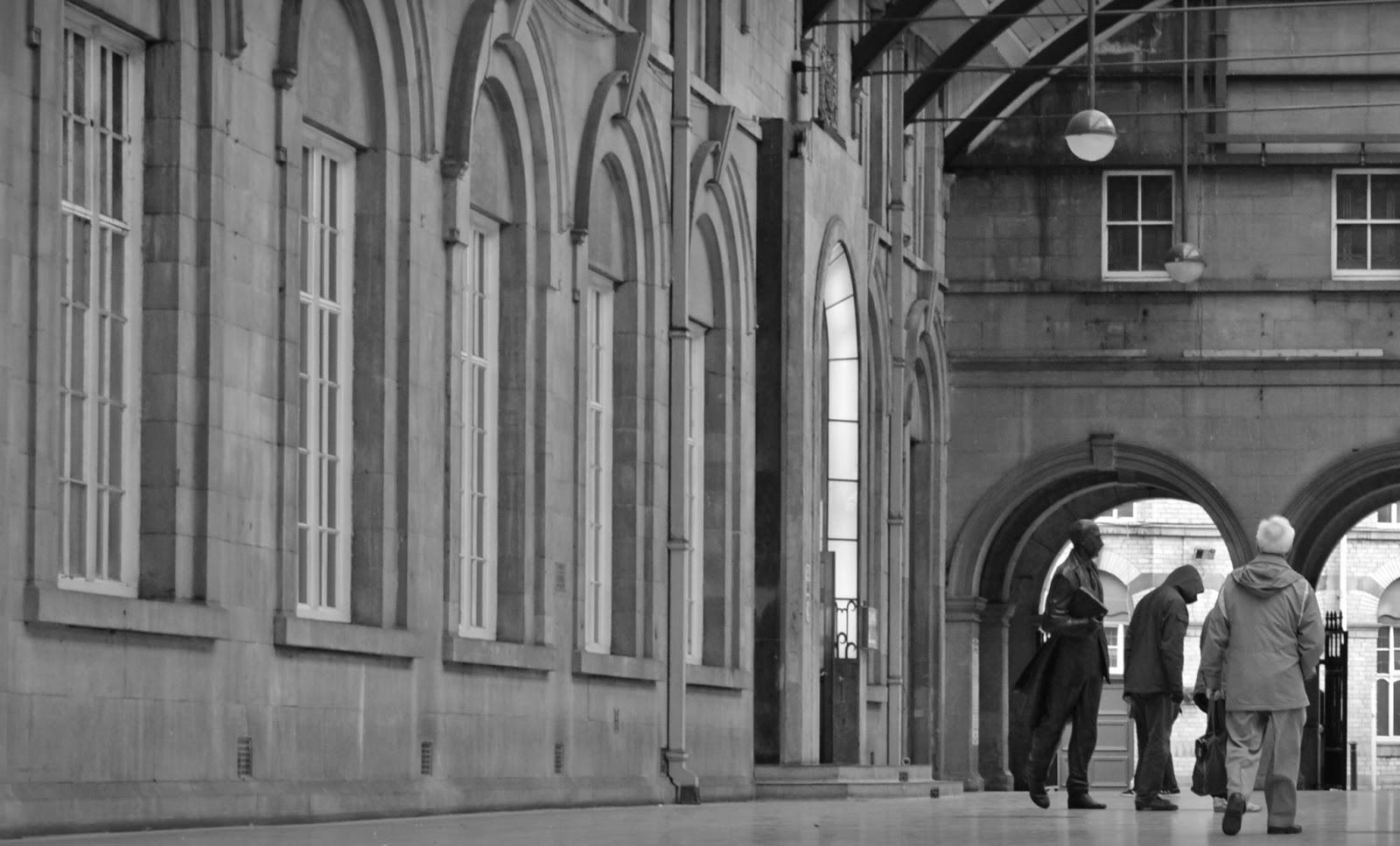
Early in the morning the Philip Larkin statue at Hull Paragon Station looks like just another darkly clad person rushing to catch his train to get to work. The statue was inspired by the opening line of his poem The Whitsun Wedding (1964) which begins “I was getting late away”. Personally, it makes me think of the white rabbit from Lewis Carroll's Alice in Wonderland. The 7 foot bronze statue was sculpted by Martin Jennings who also did the John Betjeman statue at London St. Pancras. Larkin holds onto his trilby hat with his left while clutching a manuscript under his right arm. He’s rushing towards the platforms surrounded by snippets of his own poetry, which are engraved on the floor such as this stanza from Days (1953):

What are days for?
Days are where we live.
They come, they wake us
Time and time over.
They are to be happy in:
Where can we live but days?

Who is Philip Larkin? 
He’s Hull’s little, big treasure. Born in Coventry in 1922 Larkin studied English language and literature at Oxford University. He worked as a librarian in Wellington, Shropshire and Belfast before moving to Hull in 1955 where he lived until his death thirty years later. In Hull he worked at the Brynmore Jones Library; a place where I spent too many hours on Sunday evenings trying to finish my dissertation.

He is one of England’s most popular poets and is also known as the poet laureate of disappointment. I cannot deny that this makes me smile. Hull, poetry, disappointment, grimness... and now we also have a lugubrious poet laureate of disappointment! Larkin was offered the post of poet laureate in 1984 but he actually declined as he wasn’t one to be the centre of attention and besides he didn’t feel like he had written any meaningful poetry in a long time. A year later he died of cancer.

Larkin Toad at Museums Quarter
I first heard of him during my first year at Nijmegen University when we read his poems This be the Verse (1971). From what I can tell he wasn’t the most cheerful character but rather cynical and sceptical. This shows itself beautifully when he talks about Hull. He is known for describing it as a "dump" and in regards to living here he said: 'I don't suppose I'm unhappier there than I should be anywhere else.' Clearly the kind of person you want to surround yourself with! Well, we’ll just take that as a compliment. Hull seems strangely fitting for such gloomy character, though. It’s the attitude that comes with talking about Hull. Everyone is aware of its, in my opinion, hugely undeserved bad reputation. You have to take the good with the bad and when you talk about Hull you cannot say that it is amazing because plenty of things are wrong with it. But I like it! So I find his phrasing hits the nail on the head. After all, a huge part of your happiness is linked to what you make of a place.

When I came to Hull in 2010 the city was busy commemorating Larkin’s life and opus in an event called the Larkin 25. Centrepiece of this festival were forty toad sculptures scattered all across the city. Why toads? Because Larkin wrote a poem called Toads (1954). The sculptures were later put up for auction and raised £60,000 for charity. I remember there being toads everywhere, when I got here and one of my quests was to find every single one of them. Sadly, I did not succeed because at the time I didn’t know that the toads were only on display temporarily. Quite a few toads are still around though so keep your eyes peeled. The Larkin 25 ended with the unveiling of his statue at the station on 2nd December 2010, exactly 25 years after he died. I have yet to find his grave in Cottingham and I haven’t taken a photo of his house at Pearson Park either... so... see ye later!