

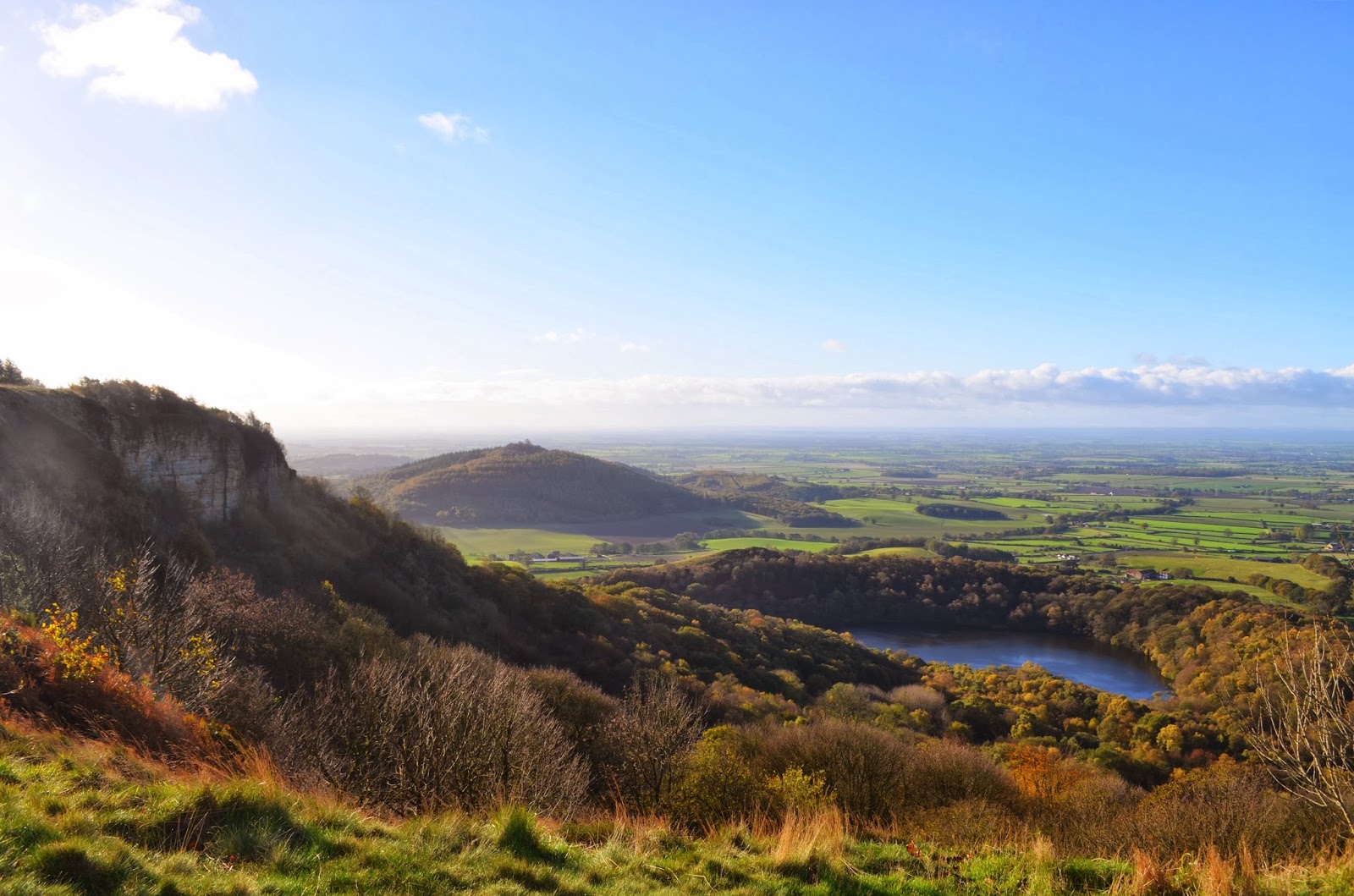
 We started at the Sutton Bank National Park Visitor Centre, which is on top of the hill, and then headed north along the bank. It was still early in the morning and the sun hadn’t had a chance to warm up the air yet. Not that I think it would have mattered much because I don’t believe it is ever warm up there as the wind is soaring over the bank like there is no tomorrow. We were in luck that the wind blew from the west because that meant it pushed us further onto the plateau rather than off the rather steep cliff to our left. Some sort of hat was in order! But it was definitely worth it, the view over green and orange hills and Gormire Lake was spectacular.
 As soon as you go down the hill and wander into the villages at the foot of Sutton Bank the wind stops and for a November day, it was actually quite warm. The downside to being in a valley in late autumn is the wetness. Every field we had to cross was waterlogged. This is not a place you want to be in while wearing puny shoes. I recently invested in some new hiking boots after my old ones started having the waterproof properties of a desert sandal. This walk certainly put the new boots to the test. Naturally, you’ll try and find the dryest way to cross a puddle but if the puddle is an entire field it can get a bit tricky. At one point, we clambered along the very edge of a field by a farm, clinging onto a barbed wire fence for dear life so that we might not fall into the knee-deep mud. It wasn’t made any easier by having spectators. Some interested cows stopped their peaceful grazing to stare at us probably wondering what those crazy humans were doing. My feet were fully submerged at times but there just was no other way across. I was rather proud of them afterwards. Though many muddy kilos heavier than before, my feet stayed dry and snug. That’ll do, boots. That’ll do.
 We were walking along fields full of livestock, cows, sheep, horses until we came to a field full of... sheep-cows? From a distance they looked like your bog-standard sheep but as you got closer their faces looked like those of young cows, and they were somehow broader than your average sheep. As we approached them, the creatures started getting uneasy, got up and all limped off. One of them exposed a strange growth on its side as it waddled up the hill. All I could think about was them being a failed attempt at crossing cows and sheep to get the best of both worlds like the potato-tomato plant that is tomato at the top and potato at the bottom - the TomTato. I don’t know what government experiment had gone wrong in this field but something wasn’t right.
After a lot of field walking we entered some woods and walked around Gormire Lake, which we could see from the top of Sutton Bank earlier. With the cliffs of Sutton Bank in the background, it felt like we were somewhere in North America and no longer in Yorkshire. It was beautiful and we came across some interesting trees and decided to rest on a birch to have some coffee and gather strength before the final push. The last bit of the walk would include climbing back up Sutton Bank but not before walking through the village with the longest place name in England (Sutton-under-Whitestonecliffe) and past the White Horse of Kilburn, which had managed to stay rather elusive thus far.

 |
| Kilburn horse and a fleeing John |


